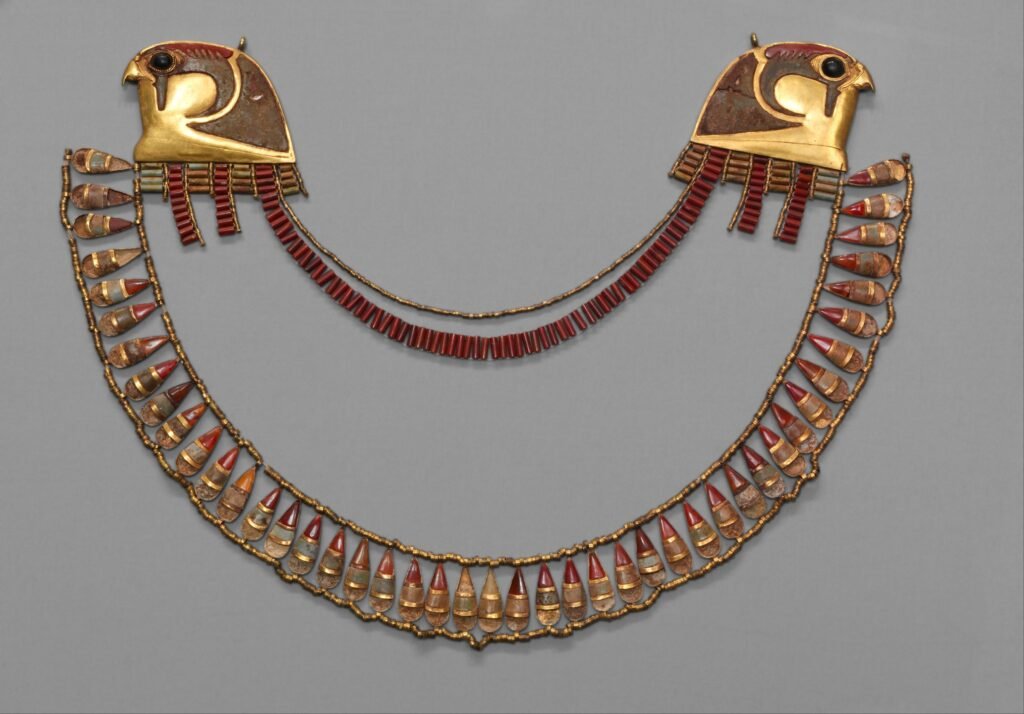
Left: A New Kingdom broad collar. Right: A Middle Kingdom broad collar.
These two objects, strikingly similar, are tails from across time—separated by nearly five centuries. Yet, they show a continuous lineage of fine crafting skills that still captivates our modern eyes.
While they seem perfect—almost impossible to create—these objects are flawed. Their lines are meticulous and disciplined, but they are not straight or mathematically flawless. Inside our modern workshops and LED-lit labs, our machines and computers can “best” these objects. We can create striking perfection with the push of a button.
Yet, the ancient works stand out in the mind. Why?
I believe it is the discipline. It is the dedication and refinement this culture maintained for centuries that pulls us in. Many of us struggle to follow the same task for a few years, or even months; yet the skill of their ancestors radiates through these objects, spanning distinct eras. We aren’t just looking at gold; we are looking at a discipline of the human hand that we have largely traded away for precision.
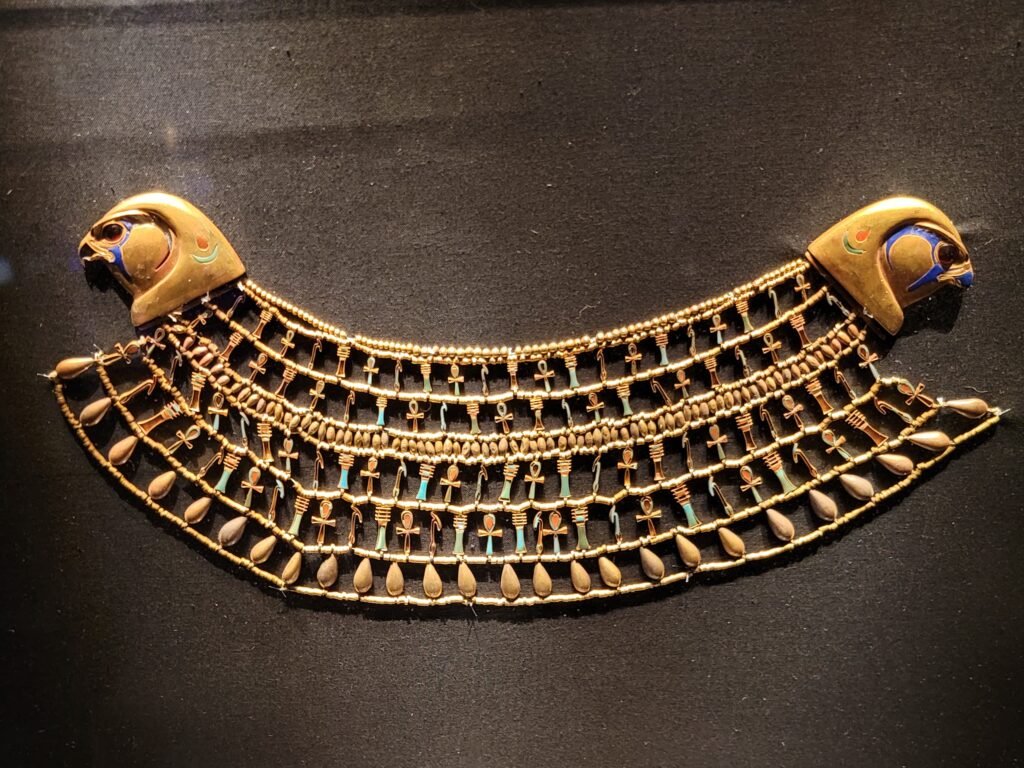
Discovered within the intact burial of Khenmet—likely a daughter of Amenemhat II, given her tomb’s location within his pyramid complex—Figure A is a truly epic work of art dating to around 1800 BCE.
The necklace features rows of hieroglyphs: the Ankh 𓋹 (S34), Was 𓌀 (S40), and Djed 𓊽 (R11), representing Life, Dominion, and Stability. Constructed of gold, lapis lazuli, and semi-precious stones, this piece demonstrates the mastery Middle Kingdom craftsmen achieved by refining techniques from the Old Kingdom.
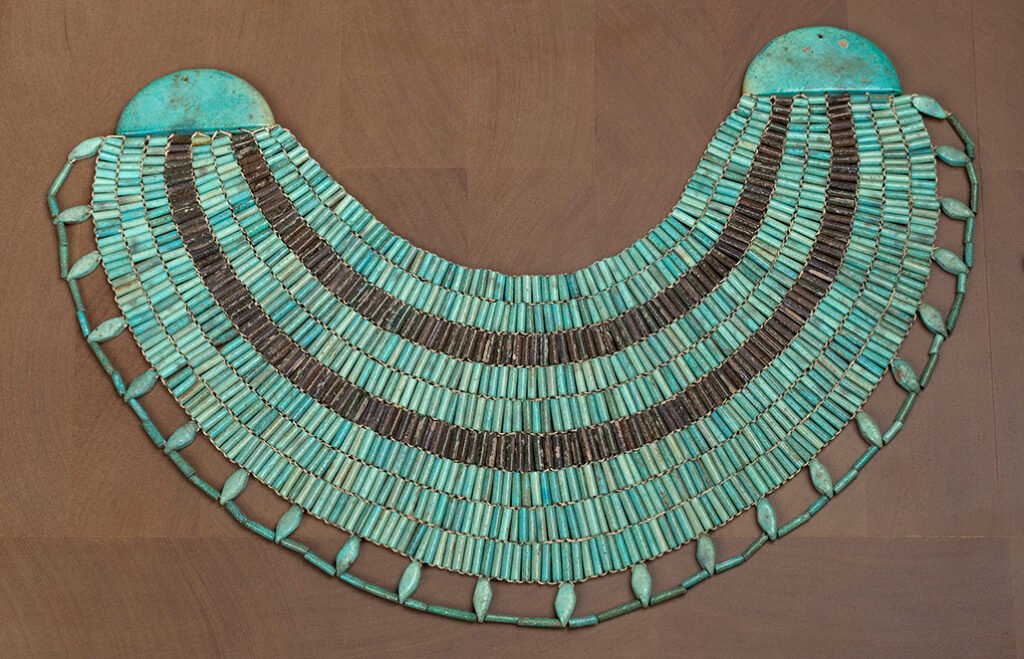
Similarly, without precious metals and absent the falcon motif, this wesekh collar belonging to Hapiankhtifi is also from the Middle Kingdom. Yet, it is very similar to an Old Kingdom wesekh collar recently discovered on the mummy of Hekashepes—possibly the oldest and most complete non-royal mummy found to date. Hekashepes dates to around the 5th or 6th Dynasty, proving that during the construction of royal pyramids, native Egyptians also began refining their skills in other ways. By the time of the New Kingdom, the wesekh is found iincorporated into the magnificent mask of Tutankhamun.
Tutankhamun’s mummy also included a wesekh separate from the mask, as the importance of protecting the Pharaoh in the afterlife demanded redundancy. To better understand this, we must look at the name itself.
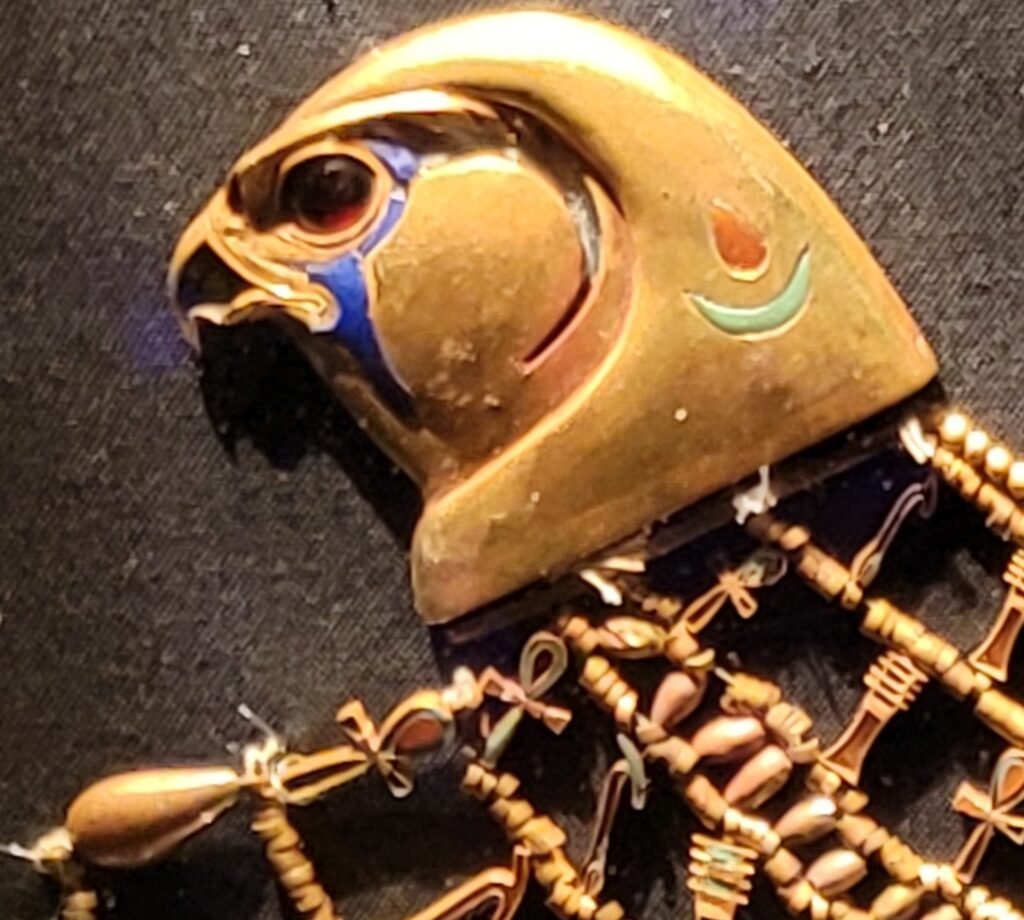
It is vital to understand that the wesekh—literally translating to ‘The Broad One’—was never merely ornamental. The name itself is rooted in the word for width, spelled with the Quail Chick (𓅱 w), Folded Cloth (𓋴 s), and Sieve (𓐍 ḫ). To the Ancients, it was a potent amulet serving a critical magical function: protecting the throat. As the channel for breath and food, the neck was seen as a vulnerable point for the deceased. By placing the wesekh on the mummy, often with terminals shaped like falcon heads representing the embrace of the god Horus, the Ancients believed they were securing the ability to breathe and speak in the Afterlife. This spiritual necessity likely drove the strict adherence to its design for thousands of years.
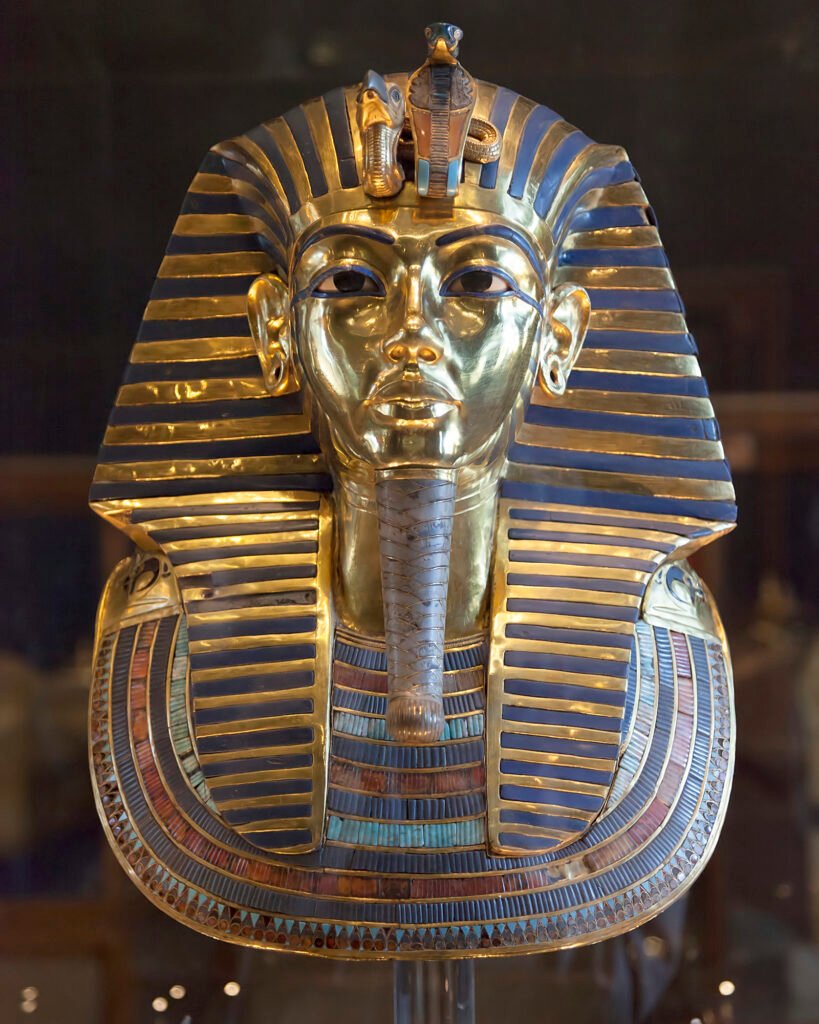
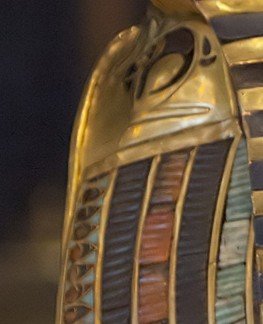
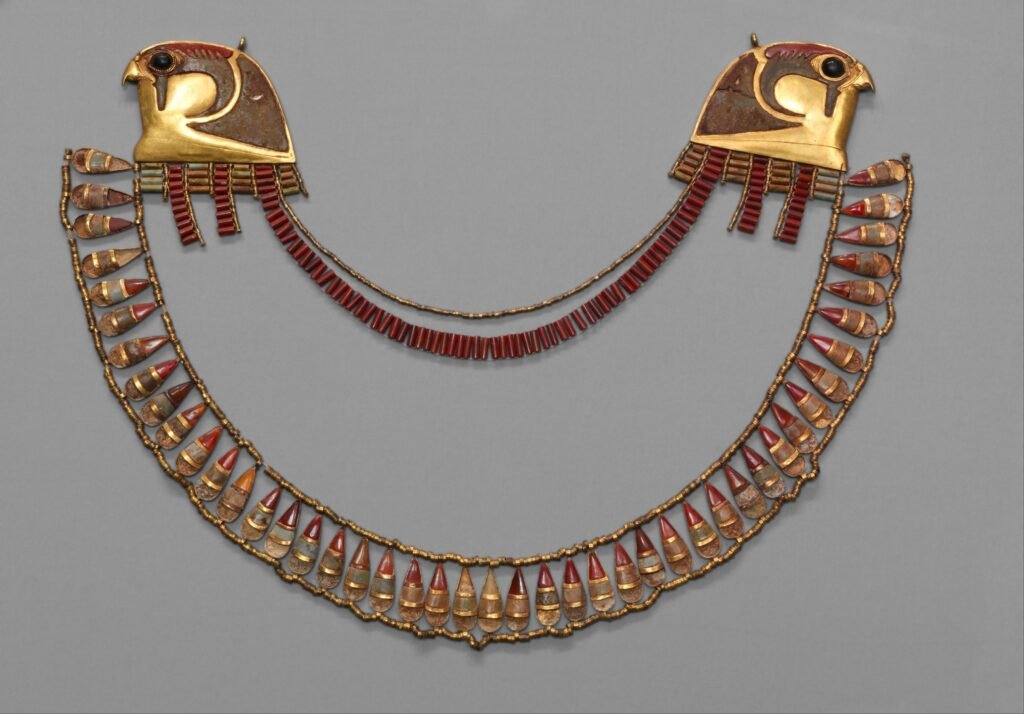
Figures C and D show the wesekh incorporated into the world-famous mask of Tutankhamun, while Figure E was found with the burial of a wife of Thutmose III, marking a continuous design tradition lasting at least 400 to 600 years.
For a moment, try to imagine just how many of these collars must have been crafted over all these years. As journeymen practiced—presumably selling to non-royals—and elite craftsmen produced these for the royal families, thousands of these objects must have been created and subsequently lost to time. What unique inscriptions were left on these lost works of art? What could we have learned from them and their small slice of the magnitude of Ancient Egyptian culture?